
Polygon Annotation Services for Precise Object Shapes
Point-by-point outlines that follow curves, gaps and odd angles, so your model learns the real shape instead of a rectangle. Traced by our in-house team from your class list and rules, and reviewed by a second person before delivery.
Your own images, traced free. NDA available on request.
- NDA on requestData used for your project only
- Two-stage reviewAnnotator, then reviewer
- Three shiftsWork moves around the clock
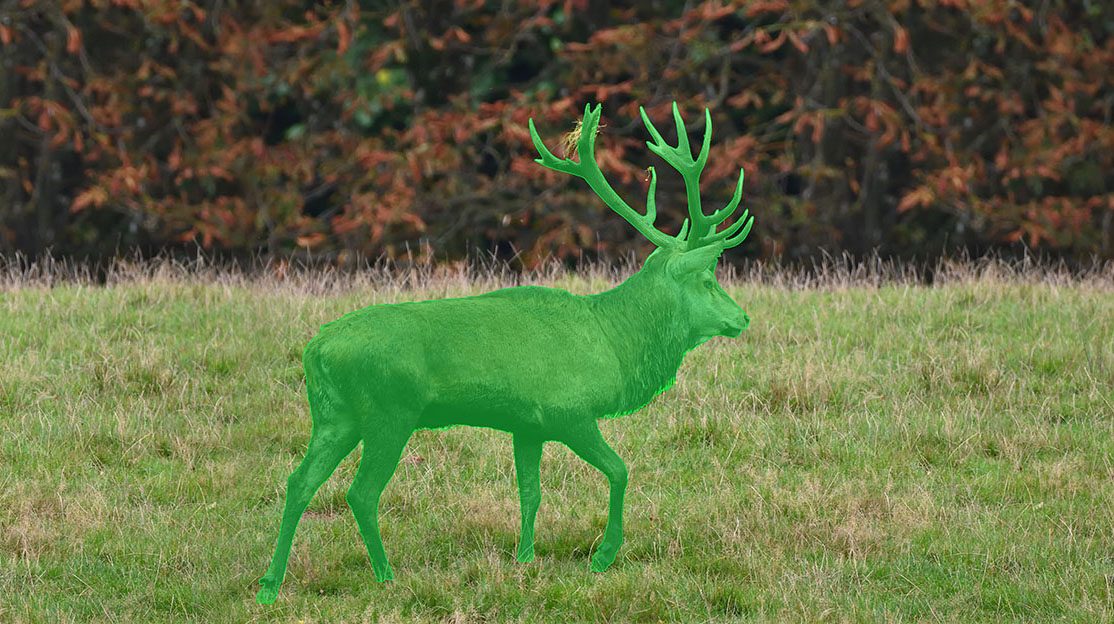 Polygon · antlers traced tine by tine
"segmentation": [[748,325, 707,110, 591,105, 481,292, 305,352, 262,593, …]]
one x,y pair per vertex · closed shape · no boxes
Outlines from real segmentation projects
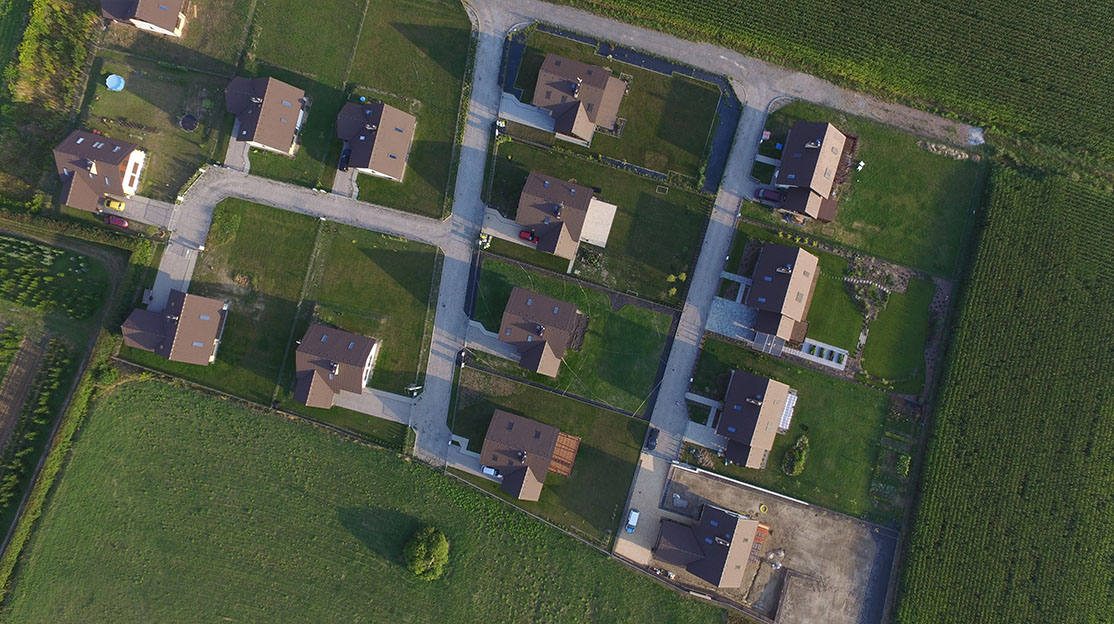
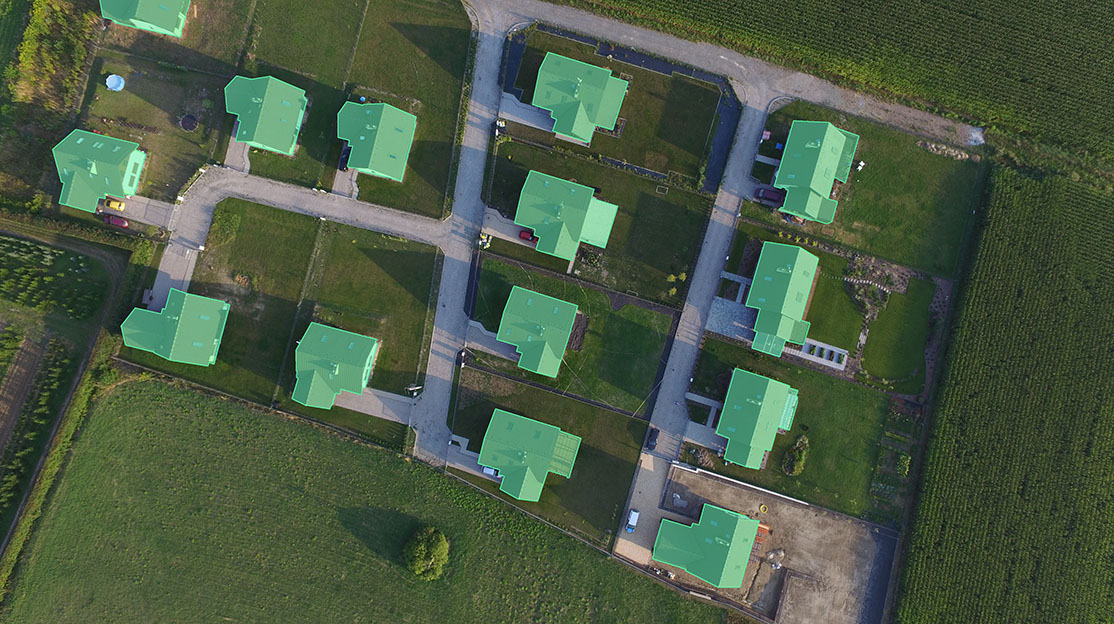
Drag to compare the raw frame with the delivered outlines.
 BeforeAfter
Drag to compare
Every rooftop, traced from above
A drone shot of a new housing estate. Each roof gets its own polygon that follows the L-shapes, extensions and porches, so the model learns real building footprints instead of rectangles that spill into gardens and driveways.
- Classes
building- Objects
- 14 polygons, one per roof
- Used for
- Mapping, urban planning, insurance and solar estimates
Outline detail agreed before the first vertex
Simple product shapes or crowded street scenes, with the level of detail fixed before we start.
Image polygon annotation
Closed outlines on single images, from a few large objects to hundreds of small ones per frame.
Video polygon annotation
Outlines tracked across frames with a stable ID per object, for tracking and video segmentation.
Instance segmentation
Every object gets its own polygon and ID, even when two of the same class touch or overlap.
AI pre-label correction
Send model-generated masks or polygons and we fix drifting edges, merged objects and misses.
Every outline on the true edge
A loose polygon teaches a model the wrong shape, and the error repeats in every prediction. Fixed rules for every annotator, a reviewer on every batch, and your data kept under control throughout.
Points on the true edge
Vertices sit on the object boundary, not inside it and not out in the background.
Detail where the shape bends
More points on curves and corners, fewer on straight edges, so files stay light without losing shape.
Hidden parts agreed in writing
Occluded objects are traced on the visible part only, or as a full shape, as signed off on the pilot.
Checked at full zoom
A reviewer inspects outlines up close and returns any that drift from the edge or overlap a neighbour.
How we handle your data
- NDA available on request
- Access limited to the people on your project
- No personal devices. Files stay on company systems
- Deleted after delivery when you ask
Pilot first. Commit after.
No contract or payment until you have seen your own images traced and approved the quote.
- STEP 01
Share samples and rules
A sample link, your class list and any outline rules, or just what the model needs to segment.
- STEP 02
Free pilot batch
We trace it in your format and note every vertex-spacing and occlusion decision.
- STEP 03
Fixed quote and schedule
A per-object price and batch plan based on your real images, not a guess.
- STEP 04
Batches on schedule
Reviewed files with progress updates from one project manager.
Built for one-off datasets and ongoing pipelines
Team size is planned around your volume and deadline. Large datasets ship in batches so training can start while tracing continues.
Project
A fixed dataset with a deadline. Scoped, traced and delivered in batches.
Ongoing stream
New data arrives daily or weekly and comes back traced on a set turnaround.
Dedicated team
Annotators trained on your guidelines and kept on your work, across three shifts.
Used by teams in automotive, retail, agriculture, healthcare, aerial and satellite imaging, manufacturing and robotics.
Is a polygon the right label?
A polygon is a closed outline of points placed along an object’s edge and tagged with a class. It is the standard input for instance segmentation models such as Mask R-CNN and YOLO-seg, at a lower cost than full pixel masks.
If you only need to find and count objects, boxes are faster. If every pixel needs a class, choose segmentation. Not sure? We’ll recommend one on the pilot.
| Label type | Best for | Detail | Link |
|---|---|---|---|
| Bounding box | Detection, counting, tracking | Rectangle | View |
| Polygon THIS PAGE | Irregular shapes, products, rooftops | Follows the outline | |
| Semantic segmentation | Scene understanding, aerial, medical | Every pixel | View |
| Pre-label correction | Large sets with model labels to fix | Same as final type | View |
Before you send data
What AI teams ask us most before a pilot.
We are happy to sign an NDA on request. Access is limited to the people on your project, files stay off personal devices, and we delete your data after delivery when you ask.
Use polygons when the object is irregular, rotated or thin, or when the background inside a box would confuse the model. People, vehicles at an angle, plants, rooftops and products with odd shapes are common cases. If you only need to find and count objects, boxes are faster and cheaper.
We agree that on the free pilot. Most projects place more points on curves and fewer on straight edges, with a maximum allowed gap between the outline and the true edge. Your rules then apply to every image.
A polygon outlines each object separately, so two touching cars are two shapes with their own IDs. Semantic segmentation colors every pixel by class, so the same two cars become one car region. Many teams use polygons to build instance masks without paying for pixel-level work.
Yes. We trace objects across frames and keep the same ID for each object through the clip, so the data works for tracking and video segmentation models.
Polygons are priced per object. The rate depends on how complex the shapes are, how many objects each image holds and how detailed your guidelines are. We send a firm quote after the free pilot, before any work is billed.
Start with a free pilot on your own data
Send a sample link and your class list. You get back:
- Labeled samples in your format
- Notes on every edge-case decision
- A fixed per-object quote and delivery plan
Rather talk first? Email info@graphicsartssolution.com. We usually reply within 24 hours.
No payment details. NDA available on request.