In real estate marketing, photos do most of the talking long before an agent ever gets a call. Buyers scroll fast. Renters scroll even faster. In just a few seconds, they decide whether a property feels worth their time. That decision is rarely logical. It’s emotional.
Over the years, working with real estate agents, photographers, and property managers, one thing becomes very clear: most listing problems don’t come from price or location — they come from presentation. And more specifically, from misunderstanding the difference between real estate photo editing and virtual staging.
They sound similar. They’re often used together. But they serve very different purposes, and using the wrong one can quietly weaken a listing.
Why This Difference Matters More Than People Think
A common situation we see is this:
An agent uploads photos straight from the camera, thinking the property looks “fine.” Technically, nothing is wrong. But the listing gets very little attention. No strong reactions. No urgency.
Then editing is applied — proper lighting correction, color balance, perspective fixes — and suddenly the same property starts getting saves, clicks, and inquiries.
Nothing about the house changed.
Only how clearly it was shown.
That’s the power of real estate photo editing.
Virtual staging, on the other hand, enters the picture when clarity alone isn’t enough. When a space is empty or outdated, buyers struggle to imagine life there. And if buyers can’t imagine themselves in a space, they emotionally disconnect — even if the property is perfect on paper.
Understanding when to edit, when to stage, and when to use both is where strong real estate marketing actually begins.
What Real Estate Photo Editing Really Does (Beyond “Making Photos Look Better”)
Real estate photo editing isn’t about making a property look unreal. In fact, the best editing is the kind you don’t notice.
Its job is to correct what the camera couldn’t capture properly.
Cameras exaggerate contrast. They flatten depth. They turn warm spaces cold and bright rooms dull. Editing fixes those technical flaws so the image matches what the human eye experienced in the space.
From experience, most editing work focuses on small but critical details:
balancing indoor and outdoor light, correcting color casts from mixed lighting, straightening walls that lean just enough to feel uncomfortable, removing tiny distractions that pull attention away from the room itself.
We’ve worked with agents who initially worried that editing might “misrepresent” the home. But after seeing properly edited images compared to raw ones, they realized something important: editing doesn’t change the truth — it restores it.
Buyers respond better when photos feel honest and clean. They trust listings more when rooms look natural instead of dramatic.
That trust directly affects how long a buyer stays on the listing, whether they save it, and whether they book a showing.
What Virtual Staging Actually Solves
Virtual staging solves a different problem — imagination.
Empty rooms are surprisingly hard for buyers to understand. Without furniture, scale disappears. A bedroom can look smaller than it is. A living room can feel awkward instead of spacious.
We’ve seen this many times with new constructions and vacant listings. The photos are clean. The editing is perfect. Yet engagement stays low.
Once virtual furniture is added — a sofa placed correctly, a bed scaled properly, a dining table that defines the space — buyers suddenly “get it.”
They don’t just see a room anymore.
They see a lifestyle.
Virtual staging doesn’t replace editing. It depends on it. Staging only works when the base image is already clean, well-lit, and realistic. Otherwise, the furniture looks fake and breaks trust.
When done correctly, virtual staging helps buyers emotionally step into the space before they ever visit it.
Difference Buyers Feel (Even If They Don’t Know Why)
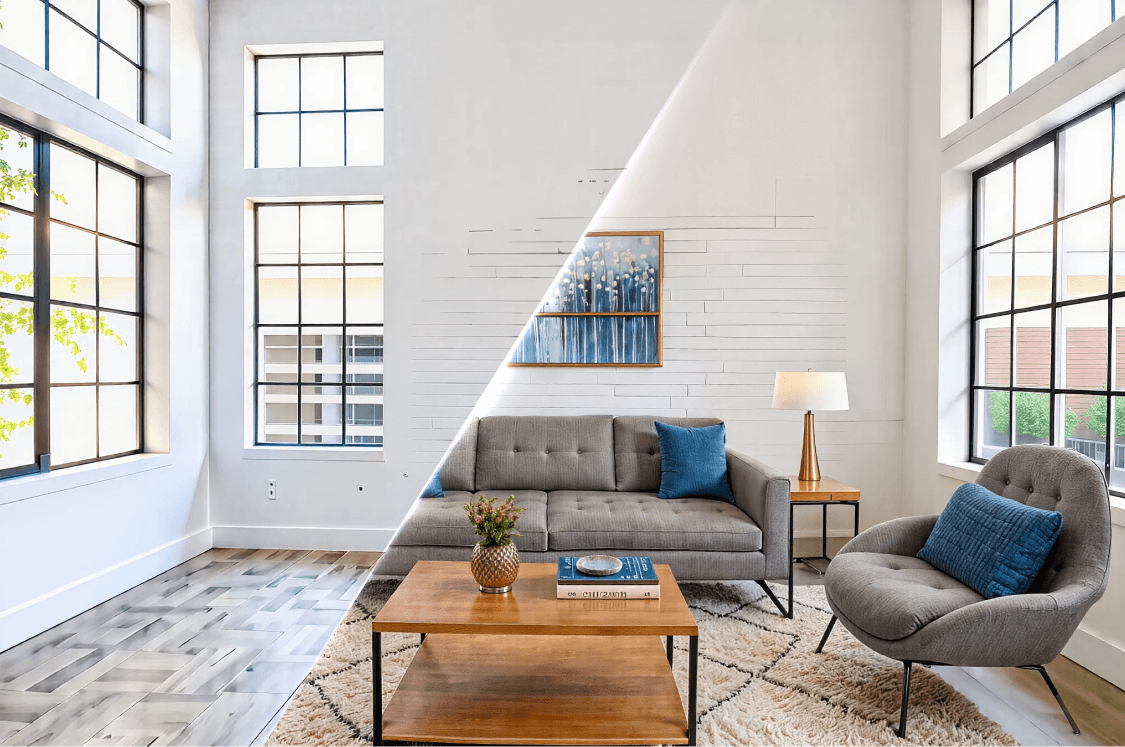
Buyers may not know the technical difference between editing and staging, but they feel the result.
Edited photos feel comfortable and believable.
Virtually staged photos feel inviting and aspirational.
One builds confidence.
The other builds desire.
That’s why the strongest listings often use both — editing first to ensure accuracy, then staging to guide imagination.
When Editing Alone Is Enough
For occupied homes that are already furnished and reasonably tidy, professional photo editing is usually all that’s needed.
We’ve worked with many agents selling lived-in homes where editing alone significantly improved results. Cleaning up small distractions, balancing light, and keeping colors consistent across photos often makes the property feel far more polished than buyers expect.
In these cases, adding virtual furniture would actually reduce authenticity.
When Virtual Staging Makes the Biggest Impact
Empty properties are where virtual staging shines.
New builds, rentals between tenants, or homes that have been fully cleared often struggle online. Buyers scroll past them because the images feel cold or incomplete.
Virtual staging helps define purpose.
It shows how a room can be used, not just what it currently is.
From real campaigns we’ve worked on, virtually staged listings often receive noticeably higher engagement — especially on platforms where buyers compare multiple properties quickly.
A Real-World Lesson Agents Learn the Hard Way
One agent we worked with insisted that editing wasn’t necessary. The photographer delivered clean images, but they were unedited. The listing went live and underperformed.
After two weeks, editing was applied. No staging. Same photos, properly corrected.
Inquiries increased almost immediately.
Later, for a different vacant property, the same agent tried editing only — and again saw weak engagement. This time, virtual staging was added.
The result?
More saves, longer listing views, and faster showings.
That’s when the difference truly clicked.
Why Google Also Prefers This Approach
From an SEO perspective, this matters too.
Google increasingly rewards content that reflects real experience, not surface explanations. Articles that explain why something works, when to use it, and what happens in real situations perform better than generic definitions.
That’s why content written from real industry experience ranks longer and survives updates.
Final Thoughts
Real estate photo editing and virtual staging aren’t competing services. They’re tools — each solving a different problem in buyer psychology.
Editing builds trust.
Staging builds emotion.
When used correctly, they work together to help buyers move from curiosity to confidence — and from scrolling to scheduling a visit.
Understanding that difference doesn’t just improve listings.
It improves results.
Frequently Asked Questions
Is real estate photo editing the same as virtual staging?
No, they are not the same. Real estate photo editing improves the quality of an existing photo by fixing lighting, colors, perspective, and small distractions. Virtual staging digitally adds furniture and decor to an image, usually for empty properties, to help buyers visualize how the space can be used.
Do I need photo editing before virtual staging?
Yes. Professional photo editing is essential before virtual staging. If the base image has poor lighting, color issues, or crooked lines, the virtual furniture will look unrealistic. Editing creates a clean, accurate foundation that makes staging look natural.
Can virtual staging replace real estate photo editing?
No. Virtual staging does not fix exposure, color balance, or perspective issues. It only adds visual elements. Without proper editing, staged photos can look fake and reduce buyer trust.
Is virtual staging misleading for buyers?
When done ethically, virtual staging is not misleading. It should only be used to show how a space could look when furnished, not to hide permanent flaws or change the structure of the property. Many agents clearly label staged images to maintain transparency.
Which is better for selling a home faster: editing or virtual staging?
Both serve different purposes. Editing helps every listing by making photos clear, bright, and professional. Virtual staging works best for empty or unfurnished properties where buyers struggle to imagine the space. Using the right method for the right situation produces the best results.
Do buyers care if photos are edited or staged?
Most buyers don’t consciously think about editing or staging, but they absolutely feel the difference. Clean, well-edited photos build trust, while staged photos help buyers emotionally connect with the space. Both influence decisions without buyers realizing why.
Is virtual staging expensive compared to photo editing?
Virtual staging usually costs more than basic photo editing because it involves design work and customization. Photo editing is faster and more affordable, while staging is a strategic investment for vacant or hard-to-sell properties.
Can real estate photo editing make a property look unrealistic?
Only if it’s done poorly. Professional editing focuses on realism, not exaggeration. The goal is to match what the property looks like in real life, not to over-brighten or over-saturate images.
Should occupied homes use virtual staging?
Usually no. Occupied homes already have furniture, so professional editing is often enough. Virtual staging is most effective for empty homes, new constructions, or spaces with outdated or missing furnishings.
How do edited and staged photos affect online listing performance?
From real-world experience, edited photos increase trust and engagement, while staged photos increase emotional appeal. Listings that use both strategically often receive more views, more inquiries, and faster decisions.